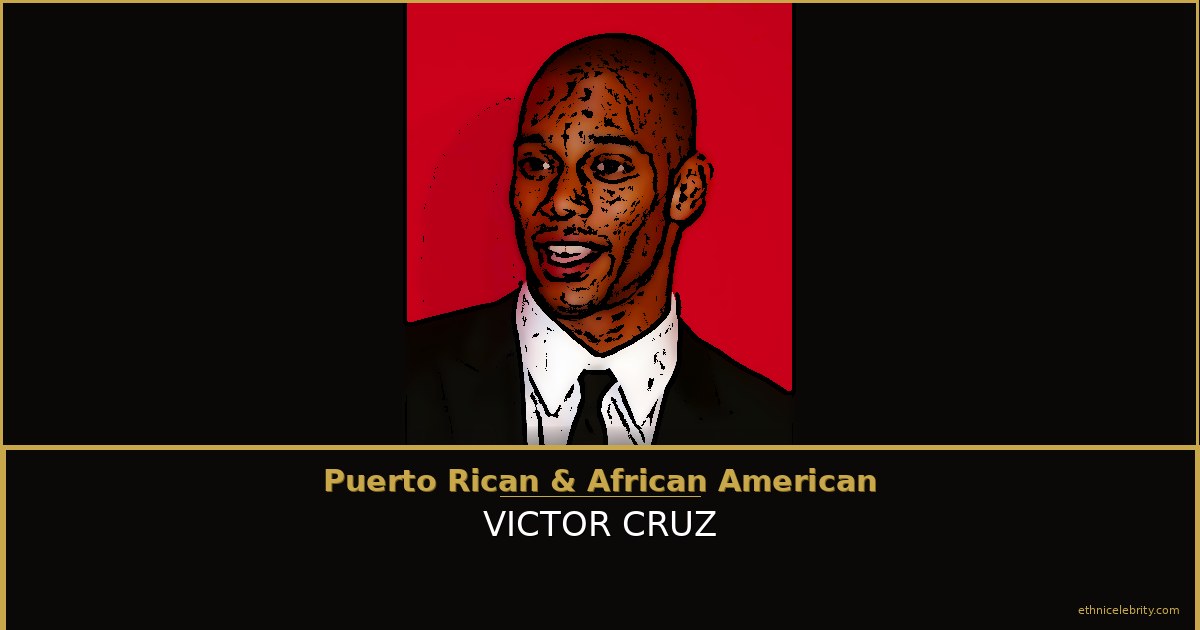
VICTOR CRUZ
Puerto Rican (maternal) + African American (paternal)
Quick Facts
▶ Watch
Victor Cruz — heritage & background
Victor Cruz Ethnicity, Race & Heritage: Is He Mixed Race? Full Background Explained
Quick answer: Yes, Victor Cruz is mixed race — his mother Blanca Cruz is Puerto Rican and his father Michael Walker is African American. Born in Paterson, New Jersey, Victor Cruz is a former New York Giants wide receiver who won Super Bowl XLVI and is known for his salsa touchdown celebration. His Puerto Rican-Black biracial heritage is a central part of his identity.
Is Victor Cruz Mixed Race? Is He Biracial?
Yes — Victor Cruz is mixed race and biracial. His mother, Blanca Cruz, is Puerto Rican — from a family with roots in the towns of Bayamón and Arecibo in Puerto Rico. His father, Michael Walker, is African American — a firefighter who died by suicide in 2007, a tragedy that deeply affected Victor. Victor was raised in a Puerto Rican household: his grandparents and his mother were all Puerto Rican, and the cultural traditions of the island permeated his upbringing in Paterson, New Jersey.
Victor Cruz's appearance — brown complexion, features reflecting his Puerto Rican and African American heritage — is consistent with his biracial background. Puerto Rican identity itself is already a blend of indigenous Taíno, Spanish, and West African ancestry, so Victor's heritage is a rich confluence of multiple streams.
So to answer the most-searched questions directly: Victor Cruz's race is Black and Puerto Rican. His background is mixed: Puerto Rican mother and African American father. His heritage is Puerto Rican (maternal) and African American (paternal). Yes — he is definitively biracial.
What Is Victor Cruz's Ethnicity?
Victor Cruz's ethnicity is a compelling blend of Puerto Rican and African American heritage. Puerto Rican identity is itself a Mestizo/triracial mix — it combines the indigenous Taíno people (the original inhabitants of Puerto Rico before European contact), Spanish colonizers and settlers, and West Africans brought as enslaved people during the colonial era. When you add an African American father to this already complex Puerto Rican heritage, the result is an extraordinarily layered ancestry.
Victor Cruz grew up deeply immersed in Puerto Rican culture — he grew up in a Puerto Rican household, speaks Spanish, and his signature salsa touchdown celebration became one of the most recognizable expressions of Puerto Rican cultural pride in NFL history. Cruz has noted that growing up "in a very Puerto Rican household" shaped his values, his identity, and his connection to the island.
Paterson, New Jersey — where Victor Cruz grew up — is a heavily Latino city with one of the largest Puerto Rican communities in the northeastern United States. The city has deep roots as an industrial center that attracted Puerto Rican migrants from the 1940s onward.
Father's Side: African American Heritage
Victor Cruz's father, Michael Walker, was an African American man who worked as a firefighter in the Paterson area. Michael Walker died by suicide in 2007, when Victor was 20 years old — a devastating loss that occurred just as Victor was beginning his college football career at the University of Massachusetts. The death of his father was one of the defining emotional experiences of Victor's life and has been discussed in interviews about his resilience.
Michael Walker's African American heritage connects Victor to the long history of Black America: West African ancestral roots brought through the Middle Passage, the survival of slavery and segregation, and the building of a culture that has shaped American music, art, sport, and justice. Victor Cruz's father contributed this heritage to a son who would go on to become one of the most electrifying wide receivers in NFL history.
Mother's Side: Puerto Rican Heritage
Victor Cruz's mother, Blanca Cruz, is Puerto Rican, with family roots in the towns of Bayamón and Arecibo. Bayamón is one of Puerto Rico's largest cities, located just west of San Juan, and is known as the "City of Chinaberry Trees." Arecibo, on Puerto Rico's northern coast, is famous for the Arecibo Observatory.
Blanca Cruz raised Victor in Paterson, New Jersey, alongside Victor's grandparents — all of whom were Puerto Rican. The family maintained Puerto Rican cultural traditions: the Spanish language, Puerto Rican food, music, and the deep pride of Boricua identity. Victor Cruz has spoken about growing up in this Puerto Rican household as formative to who he became — a young man with roots on the island who used football as his path to a larger world.
Puerto Rican heritage itself carries a triracial mix: the indigenous Taíno of the Caribbean, the Spanish colonial tradition, and the West African enslaved ancestry that entered the Puerto Rican population through the slave trade. This means Victor Cruz's heritage includes African ancestry from both his father's Black American line and his mother's Puerto Rican line.
Grandparents: A Complete Picture
Paternal Grandfather — [Name not publicly documented]: African American, from an African American family in New Jersey or the broader Northeast.
Paternal Grandmother — [Name not publicly documented]: African American, contributing to Victor's core Black American heritage through his father.
Maternal Grandfather — [Name Cruz, not fully documented]: Puerto Rican, from Bayamón or Arecibo, Puerto Rico. His heritage carries the triracial blend of Taíno, Spanish, and African ancestry that characterizes Puerto Rican identity.
Maternal Grandmother — [Name not publicly documented]: Puerto Rican, from the island. She was part of the Puerto Rican household that raised Victor in Paterson alongside his mother Blanca.
Victor Cruz in His Own Words on Race & Identity
Victor Cruz has spoken extensively about his Puerto Rican heritage and his biracial identity, often in the context of his salsa touchdown celebration and his connection to the island.
"I grew up Puerto Rican. My mom, my grandparents, the food, the music — all Puerto Rican. That's my culture, that's my identity. But I'm also my father's son. I carry him everywhere I go. Everything I do on that field is for him." — Victor Cruz, paraphrased from multiple interviews about his biracial heritage and his late father.
He has also been vocal in the NFL's Por La Cultura campaign, celebrating Latino heritage in professional football — using his platform to acknowledge the Puerto Rican community's contribution to American sport.
Is Victor Cruz Alive?
Yes, Victor Cruz is alive. Born November 11, 1986, he is currently 39 years old. After his NFL career with the New York Giants (2010–2017) — during which he helped win Super Bowl XLVI and became famous for his salsa touchdown celebration — Cruz has worked as a television analyst and remains active in public life. His signature salsa dance became one of the most iconic and culturally specific celebrations in NFL history, connecting millions of Puerto Rican fans to the game.
Visual Family Tree
VICTOR CRUZ
(Puerto Rican / African American)
Michael Walker (Father)
(African American; firefighter; d. 2007)
[Unknown]
(African American)
[Unknown]
Blanca Cruz (Mother)
(Puerto Rican; roots in Bayamón and Arecibo, PR)
[Unknown Cruz]
[Unknown Cruz]
Sources
Ethnicity & Heritage
- Wikipedia — Victor Cruz
- HuffPost — Victor Cruz and His Boricua Self
- Current Affairs — Victor Cruz Ethnicity
Biography
EthniCelebrity Research Team
Ethnicity & Heritage Writers
Our team specialises in researching and documenting the ethnic backgrounds, nationality, and ancestry of public figures — drawing on genealogical records, interviews, and verified biographical sources.