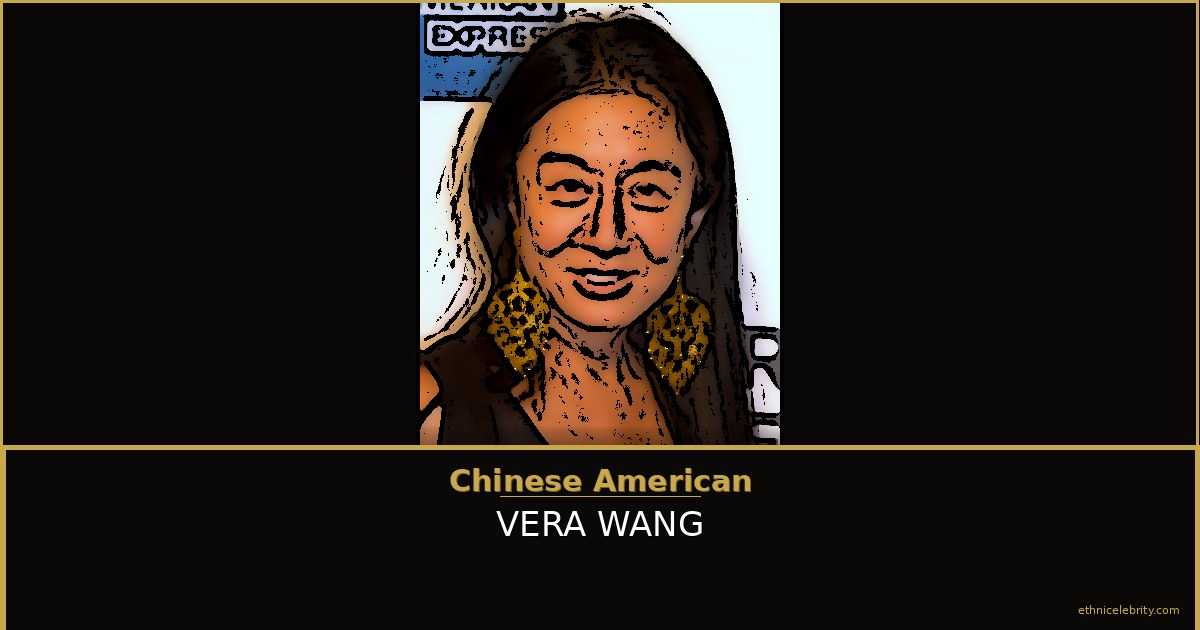
VERA WANG
Chinese American
Quick Facts
▶ Watch
Vera Wang — heritage & background
Vera Wang Ethnicity, Race & Heritage: Is She Mixed Race? Full Background Explained
Quick answer: No, Vera Wang is not mixed race — she is Chinese American. Both of her parents are Chinese immigrants who came to the United States in the 1940s. Her father Cheng Ching Wang was the son of a Chinese general, and her mother Florence Wu was the daughter of a Chinese politician.
Is Vera Wang Mixed Race? Is She Biracial?
No — Vera Wang is not mixed race or biracial. Both of her parents are Chinese immigrants who came to the United States in the mid-1940s. She is fully of Chinese heritage and identifies strongly with both her Chinese roots and her American upbringing.
Her parents encouraged her to embrace American culture while never forgetting her Chinese heritage — a balance that has characterized her life's work in fashion, where she fuses Eastern aesthetic sensibilities with Western bridal traditions.
So to answer the most-searched questions directly: Vera Wang's race is Asian. Her background is Chinese American. Her heritage is Chinese, with family roots in mainland China. She is not biracial and not mixed race.
What Is Vera Wang's Ethnicity?
Vera Wang's ethnicity is Chinese American. Born on June 27, 1949, in New York City, she grew up on Manhattan's Upper East Side in an affluent Chinese-American household. Her parents were well-educated, well-traveled Chinese immigrants who had left China and settled in New York in the 1940s.
Her father spoke fluent English — unusual among Chinese immigrants of his generation — and had attended two prestigious universities: Yanjing University in China and MIT in the United States. He owned a pharmaceutical medicine company. Her mother, Florence Wu, was a translator for the United Nations. Together they gave Vera and her brother Kenneth an elite New York upbringing that was simultaneously Chinese in culture and American in opportunity.
Father's Side: Chinese Heritage
Vera Wang's father, Cheng Ching Wang (known in America as C.C. Wang), was born in China and was the son of a Chinese general. This military and social elite background gave the Wang family its prominence in pre-Communist China. After the Chinese Communist Revolution in 1949, many members of China's educated elite emigrated to the West — Cheng Ching came to America before the revolution concluded.
He attended Yanjing University in Beijing and then MIT, where he earned an advanced degree. He built a successful pharmaceutical business in New York City. His parents — Vera's paternal grandparents — were in China, and his father's military career placed the family in the upper echelons of Chinese society.
Mother's Side: Chinese Political Heritage
Vera Wang's mother, Florence Wu Wang (also spelled Wu Chifang), was the daughter of a Chinese politician alleged to have been a warlord in pre-Communist China. She emigrated to the United States and worked for years as a translator for the United Nations — a sophisticated, globally oriented career that reflected her extraordinary education and language skills.
Florence's family background in Chinese politics and governance gave the Wang household a uniquely elite Chinese immigrant character — these were not poor or struggling immigrants but members of China's former intellectual and governing class.
Grandparents: A Complete Picture
Paternal Grandfather: [Unknown Name] Wang — Chinese general; member of the Chinese military elite; contributed to the Wang family's prominent position in pre-Communist China.
Paternal Grandmother: [Unknown Name] Wang — Chinese; of the Wang family heritage.
Maternal Grandfather: [Unknown Name] Wu — Chinese politician, alleged warlord; his political prominence contributed to Florence Wu's elite upbringing.
Maternal Grandmother: [Unknown Name] Wu — Chinese; contributed to Vera's full Chinese heritage.
Spouse's Ethnicity & Children's Heritage
Vera Wang married investor and entrepreneur Arthur Becker in June 1989 (they separated in 2012 and divorced in 2023). Arthur Becker is Jewish American of Ashkenazi heritage. Together they adopted two daughters: Cecilia (b. 1990) and Josephine (b. 1993). Their daughters' heritage blends Chinese American and Ashkenazi Jewish ancestry through adoption.
Vera Wang in Her Own Words on Race & Identity
"I celebrate my Chinese heritage and my American upbringing equally. They are both who I am. One without the other would not have produced what I have been able to create in fashion."
— Vera Wang, WWD / China Institute Blue Cloud Gala, 2018
This statement captures Vera Wang's dual cultural identity — a Chinese immigrant's daughter who grew up in the heart of New York and found her artistic voice at the intersection of Eastern and Western aesthetics. Her bridal designs, with their minimalist elegance and sculptural quality, reflect both the understated refinement of Chinese aesthetic philosophy and the drama of Western couture.
Is Vera Wang Alive?
Yes, Vera Wang is alive. She was born on June 27, 1949, making her 75 years old as of 2025. She is one of the world's most celebrated fashion designers, particularly known for her bridal gowns and her transformation of the bridal industry. She opened her first bridal boutique in 1990 and has since dressed celebrities including Michelle Obama, Beyoncé, and Kim Kardashian.
Visual Family Tree
VERA WANG
(Chinese American)
CHENG CHING WANG
(Chinese American — son of Chinese general)
[Unknown]
[Unknown]
FLORENCE WU WANG
(Chinese American — daughter of Chinese politician)
[Unknown]
[Unknown]
Sources
Interviews & Direct Quotes
- WWD: "Vera Wang Celebrates Chinese Heritage and American Upbringing at China Institute's Blue Cloud Gala" — https://wwd.com/fashion-news/fashion-scoops/vera-wang-chinese-heritage-american-upbringing-at-china-institutes-blue-cloud-gala-11041976/
Genealogy & Ethnicity Research
- Wikipedia: Vera Wang — https://en.wikipedia.org/wiki/Vera_Wang
- EthniCelebs: Vera Wang — https://ethnicelebs.com/vera-wang
EthniCelebrity Research Team
Ethnicity & Heritage Writers
Our team specialises in researching and documenting the ethnic backgrounds, nationality, and ancestry of public figures — drawing on genealogical records, interviews, and verified biographical sources.