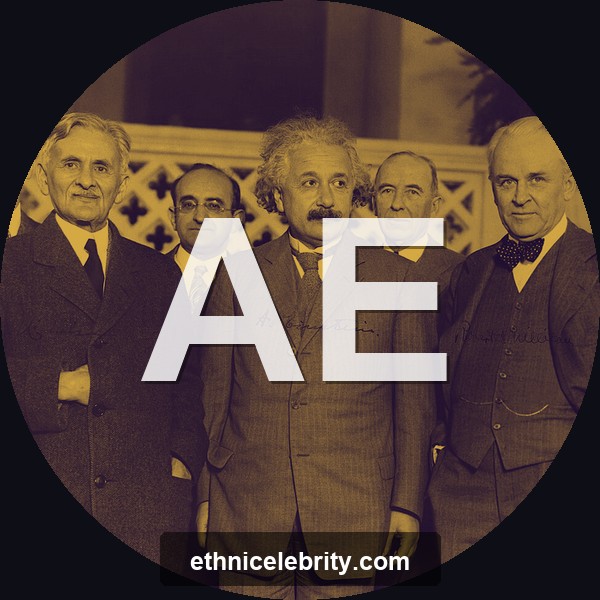
ALBERT EINSTEIN
Ashkenazi Jewish, German
Quick Facts
▶ Watch
Albert Einstein — heritage & background
Quick answer: Albert Einstein was ethnically Ashkenazi Jewish, born into a secular Jewish family in Ulm, Germany, on March 14, 1879. Both his parents — Hermann Einstein and Pauline Koch — were Ashkenazi Jews from the Swabian region of southern Germany. Einstein held German, Swiss, and American citizenship at various points in his life.
Was Albert Einstein Mixed Race? Was He Biracial?
No, Albert Einstein was not mixed race or biracial. Both of his parents were Ashkenazi Jews from the Swabian region of southern Germany. His heritage was ethnically homogeneous — fully Ashkenazi Jewish on both sides. The Ashkenazi Jewish community in Germany had been established for centuries and constituted a distinct ethnic and cultural group within German society.
However, Einstein's identity was complex. He was culturally German in terms of language, education, and upbringing, while ethnically Jewish. This dual identity — German and Jewish — became a source of tension throughout his life, particularly as antisemitism intensified in Germany during the early 20th century. Einstein's experience navigating these overlapping identities is central to understanding his heritage.
What Is Albert Einstein's Ethnicity?
Albert Einstein's ethnicity was Ashkenazi Jewish. The Ashkenazi Jews are one of the largest Jewish diaspora groups, historically concentrated in Central and Eastern Europe, particularly in Germany, Poland, and Russia. Einstein's family had deep roots in the Jewish communities of Swabia, a historic region in what is now the German state of Baden-Württemberg.
Einstein was born on March 14, 1879, in Ulm, a city in the Kingdom of Württemberg, which was part of the German Empire. Shortly after his birth, the family moved to Munich, where his father Hermann and uncle Jakob founded an electrical equipment company. The Einsteins were secular Jews who did not strictly observe religious traditions, though they maintained their Jewish cultural identity.
Growing up in Munich, young Albert attended a Catholic elementary school, which was common for middle-class families in the area regardless of religion. He later attended the Luitpold Gymnasium. Despite being raised in a largely secular household, Einstein received some Jewish religious instruction and briefly went through a phase of deep religious devotion as a child before turning to science and philosophy. His Jewish heritage remained a constant thread in his identity, even as his relationship with organized religion evolved.
Father's Side: Ashkenazi Jewish Roots from Swabia
Hermann Einstein was born on August 30, 1847, in Buchau, Kingdom of Württemberg (now Bad Buchau, Baden-Württemberg). He was the son of Abraham Einstein and Helene Moos, both Ashkenazi Jews from the Swabian region. The Einstein family had been present in the area for generations, part of the established Jewish communities that had existed in southern Germany since the medieval period.
Hermann was a salesman and engineer who later co-founded an electrochemical factory in Munich with his brother Jakob. He was a relatively successful middle-class businessman, though the family's fortunes fluctuated over the years. When his Munich-based business failed, Hermann moved the family to Italy, first to Milan and then to Pavia, seeking new opportunities.
Hermann Einstein died on October 10, 1902, in Milan, Italy. His death deeply affected Albert, who was 23 at the time. Hermann's influence on Albert was significant — he encouraged his son's early interest in science and mathematics, and the family's emphasis on intellectual curiosity laid the groundwork for Albert's later achievements.
Mother's Side: Ashkenazi Jewish Heritage
Pauline Koch was born on February 8, 1858, in Cannstatt, Kingdom of Württemberg (now part of Stuttgart). She was the daughter of Julius Derzbacher (who later adopted the surname Koch in 1842) and Jette Bernheimer. Like the Einsteins, the Koch family were established Ashkenazi Jews from the Swabian region.
Pauline came from a relatively prosperous family. Her father Julius was a successful grain dealer. She married Hermann Einstein on August 8, 1876, and together they had two children: Albert (born 1879) and Maria "Maja" Einstein (born 1881). Pauline was known as a cultured woman with a strong interest in music, and she encouraged young Albert to play the violin — a practice he continued throughout his life.
Pauline Koch Einstein died on February 20, 1920, in Berlin. Her influence on Albert's cultural development, particularly through music, was a significant part of his upbringing and shaped his lifelong appreciation for the arts alongside science.
Grandparents: A Complete Picture
On Albert Einstein's paternal side, his grandparents were Abraham Einstein and Helene Moos. Abraham was from the Jewish community in Buchau, a town in Swabia that had one of the oldest Jewish communities in the region, dating back to the medieval period. The Einstein family had been part of this community for generations.
On his maternal side, Albert's grandparents were Julius Derzbacher (later Koch) and Jette Bernheimer. Julius was a grain dealer who had changed his surname from Derzbacher to Koch in 1842, likely to assimilate more easily into German society — a practice common among German Jews at the time. Both grandparents were Ashkenazi Jews from the Württemberg region, and their family was comfortably middle-class.
All four of Einstein's grandparents were Ashkenazi Jews from the Swabian region of southern Germany, reflecting the deep roots of the Jewish community in that area.
DNA & Genetic Ancestry
Albert Einstein passed away in 1955, well before the era of consumer DNA testing. He did not take a 23andMe or AncestryDNA test. However, based on extensive genealogical research and historical records, his heritage is well-documented as fully Ashkenazi Jewish on both sides.
Interestingly, Einstein's brain was preserved after his death by pathologist Thomas Stoltz Harvey, and it has been the subject of numerous scientific studies. However, these studies focused on neuroanatomy rather than genetic ancestry. Based on documented family history spanning several generations in the Swabian region of Germany, Einstein's Ashkenazi Jewish heritage is firmly established through genealogical records rather than genetic testing.
Nationality vs. Ethnicity
Albert Einstein's relationship with nationality was remarkably complex and evolved throughout his life. He was born a subject of the Kingdom of Württemberg in the German Empire in 1879. In 1896, at age 17, he renounced his German citizenship — partly to avoid military conscription — and was effectively stateless for several years. He became a Swiss citizen in 1901 and retained that citizenship for the rest of his life.
After rising to fame, Einstein reclaimed German citizenship in 1914 when he accepted a position at the Prussian Academy of Sciences in Berlin. He held dual German and Swiss citizenship until 1933, when the Nazi regime came to power and Einstein renounced his German citizenship for the second and final time. In 1940, he became an American citizen, making him a dual Swiss-American citizen for the last 15 years of his life.
His ethnicity, however, remained constant: Ashkenazi Jewish. While his national identity shifted between German, Swiss, and American, his ethnic and cultural identity was rooted in the Jewish communities of southern Germany. This distinction became especially poignant during the rise of Nazism, when Einstein's Jewish ethnicity made him a target of persecution despite his immense contributions to German science and culture.
Albert Einstein in His Own Words
Einstein's relationship with his Jewish identity evolved significantly over his lifetime. In his early years, he distanced himself from organized religion and Jewish communal life. However, as antisemitism grew in Germany during the 1920s and 1930s, Einstein became increasingly vocal about his Jewish identity and became a prominent supporter of cultural Zionism.
Einstein publicly identified with the Jewish people and advocated for the establishment of a Jewish homeland, though he favored a binational state rather than an exclusively Jewish one. He was offered the presidency of Israel in 1952 but declined, stating that he lacked the natural aptitude and experience for dealing with people.
Relationships and Children
Albert Einstein married twice. His first wife was Mileva Maric, a Serbian physicist whom he married in 1903. Maric was of Serbian Orthodox Christian heritage, making their union an interethnic and interfaith relationship that Einstein's mother initially opposed. They had three children: a daughter Lieserl (born 1902, whose fate remains uncertain), Hans Albert Einstein (born 1904), and Eduard Einstein (born 1910). Einstein and Maric divorced in 1919.
Einstein's second wife was Elsa Einstein, whom he married in 1919, the same year his first marriage ended. Elsa was both his first cousin on his mother's side (their mothers were sisters) and his second cousin on his father's side (their grandfathers were brothers). She was also of Ashkenazi Jewish heritage. Elsa had two daughters from a previous marriage, Ilse and Margot, whom Einstein helped raise. Elsa died in 1936.
Is Albert Einstein Alive?
No, Albert Einstein passed away on April 18, 1955, at the age of 76, at Princeton Hospital in New Jersey, United States. The cause of death was an abdominal aortic aneurysm. He had been a professor at the Institute for Advanced Study in Princeton since emigrating to the United States in 1933. Einstein remains one of the most renowned and influential scientists in human history, best known for his theory of relativity and his contributions to quantum mechanics.
Visual Family Tree
Albert Einstein (Ashkenazi Jewish)
Hermann Einstein (Ashkenazi Jewish — Buchau, Württemberg)
Abraham Einstein (Ashkenazi Jewish — Swabia) · Helene Moos (Ashkenazi Jewish — Swabia)
Pauline Koch (Ashkenazi Jewish — Cannstatt, Württemberg)
Julius Derzbacher/Koch (Ashkenazi Jewish — Württemberg) · Jette Bernheimer (Ashkenazi Jewish — Württemberg)
Sources
- https://en.wikipedia.org/wiki/Albert_Einstein
- https://en.wikipedia.org/wiki/Einstein_family
- https://www.britannica.com/biography/Albert-Einstein
- https://treemily.com/blog/albert-einstein-family-tree/
- https://aeon.co/essays/einstein-on-the-practical-matters-of-being-german-and-jewish
- https://www.myjewishlearning.com/article/albert-einstein/
EthniCelebrity Research Team
Ethnicity & Heritage Writers
Our team specialises in researching and documenting the ethnic backgrounds, nationality, and ancestry of public figures — drawing on genealogical records, interviews, and verified biographical sources.